
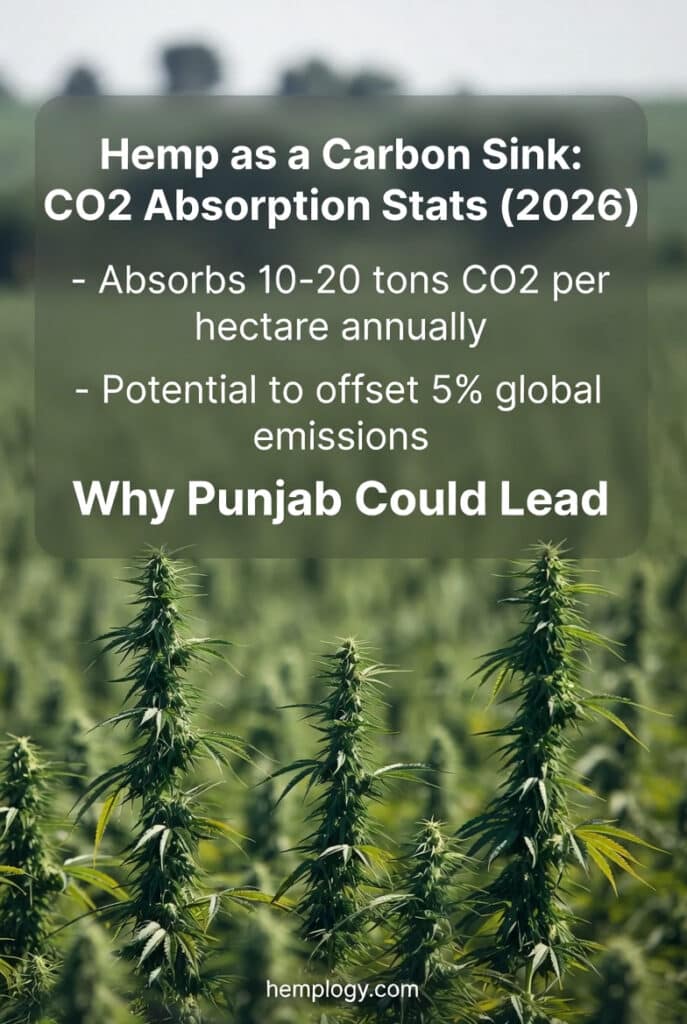
Punjab’s sun is brutal, stubble burning still chokes the air, and water scarcity is real. Imagine a crop that grows like it’s on steroids, sips less water than cotton, and eats CO₂ for breakfast. That’s industrial hemp — the non‑psychoactive cousin of cannabis, finally recognized as a climate fighter.
Hemp’s Superpower: CO₂ Absorption
- Growth cycle: 100–120 days
- CO₂ absorbed per hectare: 8–22 tonnes per cycle
- Annual potential (2 crops): 16–44 tonnes per hectare
- Comparison: Forests absorb 2–6 tonnes/year
👉 Hemp is basically the Maggi noodles of carbon capture — fast, filling, and eco‑friendly.
Table: CO₂ Absorption per Hectare
| Source | CO₂ Absorbed (tonnes/ha) | Notes |
|---|---|---|
| Cambridge University (Darshil Shah) | 8–15 | Twice forests; cited in Dezeen 2021, CarbonCredits.com 2022–24 |
| European Commission (Agri reports) | 9–15 | 5‑month cycle; 2024–25 update |
| British Hemp Co. | Up to 22 | Single crop; double with two crops |
| Morningstar/AccessWire (2025) | 8–22 | Global scaling potential |
| Tao Climate (2025) | Up to 15 | Rapid sequestration in 100 days |
1. Policy & Legal Context (India/Punjab Angle)
While hemp’s carbon sink potential is clear, its adoption in Punjab hinges on legal clarity. Under India’s NDPS Act, hemp cultivation is permitted only for industrial and research purposes, with THC limits strictly enforced. States like Uttarakhand and Uttar Pradesh have already issued licenses, and Punjab could follow suit. If policies align with climate goals, hemp could become a dual solution: reducing stubble burning emissions while creating a new green economy. Linking this to India’s net-zero 2070 pledge strengthens the climate narrative.
2. Economic Incentives & Carbon Credits
Carbon markets are booming — with biochar credits sometimes trading above $500/tonne. Farmers in Punjab could earn not just from hemp fiber and seed sales, but also from carbon credits tied to sequestration. Imagine a Bathinda farmer offsetting Delhi’s traffic emissions while selling hempcrete to builders. This positions hemp as both an income diversification tool and a climate solution, making adoption more attractive. Outbound links to CarbonCredits.com or European Commission agriculture pages would validate this.
3. Global Comparisons & Future Outlook
Globally, hemp is being trialed in drought-hit California, regenerative farms in Europe, and grazing lands in Australia. Studies project that scaling hemp on degraded lands could absorb 10 billion tonnes of CO₂ annually. For Punjab, this means joining a global movement while solving local problems — water stress, soil degradation, and air pollution. Adding a comparison to cotton’s water footprint and lifecycle emissions makes the case stronger for policymakers and eco-conscious readers.
Hemp vs Trees: Sprint vs Marathon
Hemp: Captures CO₂ fast, twice forests per year, usable in products like hempcrete.
Trees: Store carbon for decades, but slower growth.
Funny take: Trees = slow‑cooked biryani 🍲, Hemp = pressure‑cooker Maggi 🍜. Both matter, but hemp fits India’s fast farming cycles.
Hemp Carbon Stats 2026
Per hectare: 8–22 tonnes CO₂ per cycle
Global potential: 10 billion tonnes/year if scaled on grazing lands
Biochar bonus: Locks carbon for centuries at ~$45/tonne (vs $600 for tech solutions)
India angle: Punjab’s soil + sun = perfect hemp fields, plus carbon credit income.
Conversion: Per Acre
1 hectare ≈ 2.5 acres
8–15 tonnes CO₂/ha → 3.2–6 tonnes CO₂/acre
22 tonnes CO₂/ha → ~8.8 tonnes CO₂/acre
US studies: 2–3 tonnes carbon stored in soil per acre
Wrapping Up
Hemp isn’t magic, but it’s fast, versatile, and proven. In Punjab: less water than paddy, no stubble burning, income from fiber + carbon credits. Globally: billions of tonnes CO₂ removal potential.
Next chai‑stall debate? Drop this line: “Trees nap, hemp hustles. Plant both, but let hemp do the sprint.”
📚 Sources & Citations
- CarbonCredits.com (2022–24 updates)
- European Commission Agriculture (2024–25)
- Morningstar/AccessWire (2025 study)
- ScienceDirect Hempcrete LCA (2024)
- Comparative LCA Hemp vs Cotton (2025 journal)
- Dezeen/Cambridge University interviews (2021)
- Hudson Carbon & Hebe Wellness (2022–25)